In architecture, a project rarely goes by its first name. Often begins with a plot number, street name, or internal site reference. Something practical, not permanent. As the project develops, branding changes, a public identity emerges, and the title of the original work is changed.
For companies with large teams and thousands of historic projects, this is not a one-time correction. It becomes a background task that quietly takes up time every week of people whose real job is something completely different.
The solution is not more discipline or tighter spreadsheets. This is a master record where you update once and the changes propagate to wherever the project is linked.
What’s in this article
- Why renaming projects poses CV operational risks
- Why manual CV management fails on an enterprise scale
- What the master recording actually looks like
- Filtering projects for an RFP isn’t AI, it’s metadata
- Design company wrinkles: InDesign and visual delivery
- A practical checklist before you change your CV workflow
- Frequently asked questions
- Final Thoughts
Why renaming projects poses CV operational risks
New opportunities often start with a very small structure: a plot of land, an internal reference, or a temporary project label. The team still moves forward with planning and concepts using whatever identifiers are available.
Later, the project developed. A formal identity was introduced, branding was defined, and work names were changed.
That’s when the real administrative burden begins.
Someone has to keep track of every CV, project sheet and internal profile that still uses the old name. Every reference needs to be updated. Each record should be checked to avoid duplicate entries under both identities. And every team, from HR to business development to marketing, must stay aligned. Multiply this over years of project evolution and hundreds of name changes, and the problem becomes structural rather than occasional.
“Then I had to go back and check every single person that was there to make sure that the names were changed correctly and that we weren’t duplicating the same thing. It was just a lot of data and a lot of manual work.”
And this is just one person, on one project.
The same patterns repeat across scope changes, role updates, client rebrands, and project handovers. A CV is not static, it is constantly being rewritten in parts throughout the organization.
Why manual CV management fails on an enterprise scale
CV maintenance is rarely a person’s full-time responsibility. This is usually a small part of a person’s job: the marketing coordinator or lead updates the master spreadsheet and manually copies the changes into individual CVs.
On the surface, the process appears functional. But as time goes by, a gap appears between the main truth of the project data and the CV actually included in the proposal.
Senior consultants can execute 100+ projects. The leadership team may represent thousands of people. The maintenance burden exceeds what any individual can realistically control.
Why don’t companies hire more CV editors?
Because the problem is not a shortage of labor. This is a data structure problem masquerading as a workforce problem.
Adding a second or third person to the CV team gives you faster manual updates, but also doubles the risk of inconsistencies. Some editors working on unlinked files create several versions of the same information. The structural fix is to remove manual steps completely, not expand staff around them.
What the master recording actually looks like
The idea is simple: each project exists once, is connected to the people involved, and is managed from a single source of truth. When project information changes, each connected CV reflects it automatically.
In a well-structured CV management system, each project exists as a master record containing its core data: client, location, scope, timeline, certifications and supporting documents. Consultants connect to these notes with role-specific data, while shared project information remains centralized.
What does “assign a project to multiple people at once” actually mean?
This means creating a project once and attaching it to multiple consultants in one action, instead of duplicating descriptions across Word files.
If the project then obtains a certification, testimonial, or case study, it will be attached to the same master record. Each linked CV is updated automatically without reopening individual files.
The same structure applies to certifications, registrations, academic degrees, and publications: all of which are usually scattered across folders, spreadsheets, and inboxes.
Centralizing it eliminates the constant cycle of “do we have a PDF?” request.
Filtering projects for an RFP isn’t AI, it’s metadata
RFP requests often sound like AI problems on the surface: “We need hospitality projects in Mexico. Take the 10 most relevant projects from this consultant’s CV.”
If every project has structured attributes, industry, geography, scope, then “hospitality projects in Mexico” is not a generative task. That is a question. The reason companies use AI language here is because their data is unstructured. Projects exist as narrative descriptions in Word files, with no consistent tagging behind them.
“So it seemed like our team had to sort through every brief it had to choose the best one. So I think, in a perfect world for us, it wouldn’t matter if the master sat in the cloud and the AI relied on what the RFP said it helped us do.”
Once structured, the workflow becomes trivial: select consultants, apply filters, export results. What used to take hours now takes minutes. This is the same logic that drives the time savings described in our breakdown of how consulting firms can reduce handover times by 10x.
| Task | Today’s manual workflow | Master record workflow |
|---|---|---|
| Change the project name across all linked CVs | Open each file, find and replace, check for duplicates | Update the master project once, every linked CV will inherit it |
| Added new project to 10 people | Write in 10 Word files | Create one master project, connect 10 consultants in one action |
| Selecting projects for RFP | Read 124 blurbs manually | Filter by industry and country, export suitable subsets |
| Store certificates and registrations | Scattered PDF and Excel tracking | Linked to parent project or consultant notes |
| Maintain consultant CV | One person is less than 1% of the job function | Distributed, with consultants reviewing their own profiles |
Design company wrinkles: InDesign and visual delivery
For architecture and design firms, there are specific complications that most CV tools ignore. An RFP response is not a simple document. It is an InDesign package with custom layouts, embedded visuals, and a level of design control that reflects design-led practices.
Consultant CVs are rarely sent alone. This is one section in a 100-page proposal that includes scope, costs, project experience, and visual case studies. The team needed the resume content to flow naturally into the broader InDesign document, rather than as a standalone PDF that had to be screenshot and pasted.
Can CV systems export directly to InDesign?
It can export files that are 100% compatible with InDesign, because Indesign can convert docx easily. Structured Word exports that map neatly into predefined InDesign templates solve the problem in practice. The key is not the final file type, but rather the consistency of the upstream structure.
A realistic workflow for most design companies is to define an InDesign template once, then produce structured Word output that flows into it without reformatting. Any adjustments occur at the template level, not at the individual CV editing level. For more on how template behavior drives this, our CV templates page explains how a custom layout was created from a blank Word document in around two hours.
This is the kind of red line that differentiates design-led practices from typical consulting firms. This is not a nice thing to have. This is the difference between the workflow a team will adopt and the workflow they will silently direct. If a system cannot produce a format that the proposal team actually uses, then any other value is theoretical.
A practical checklist before changing your CV workflow
- Identify who is managing the CV and how much of a role they represent
- Review how many project name changes have occurred in the last two years
- Measure how long a recent RFP selection actually took
- Define required structured fields (industry, geography, scope, date, role, team size)
- Map out where certifications and credentials currently reside
- Plan a structured migration rather than rebuilding manually
For consulting and architectural firms who are answering this question for the first time, the checklist in this CEO-level checklist on whether you need a company CV manager is a good companion read. It tests operational cases before any vendor conversations.
Frequently Asked Questions
No. Most CV and RFP workflows fail because the underlying data is unstructured. The core issue is metadata and system design, not AI capabilities.
Not necessarily. In most companies, CV maintenance is only a small part of a person’s role. The problem is that manual ownership does not develop and creates inconsistencies.
Yes, but only if the project is kept as a master record and linked to the consultant. Without such a structure, updates would have to be performed manually across individual files.
Adding more people will increase speed but also increase inconsistency. Multiple editors working on unlinked files create conflicting versions of the same information.
No. In design-oriented practices, output formats such as InDesign remain essential. The key is to structure the upstream data so that it can fit existing templates neatly.
The biggest disadvantage is not the time spent updating files, but the accumulation of inconsistencies: outdated project names, duplicate entries, and missing or misaligned credentials across documents.
Final Thoughts
If project name changes still require manual updates across individual files, skilled people will be hired to maintain the data that should look after itself.
The cost is not just time, but also inconsistency: duplicate records, missing credentials, outdated project histories, and proposals that silently deviate from the company’s real experience.
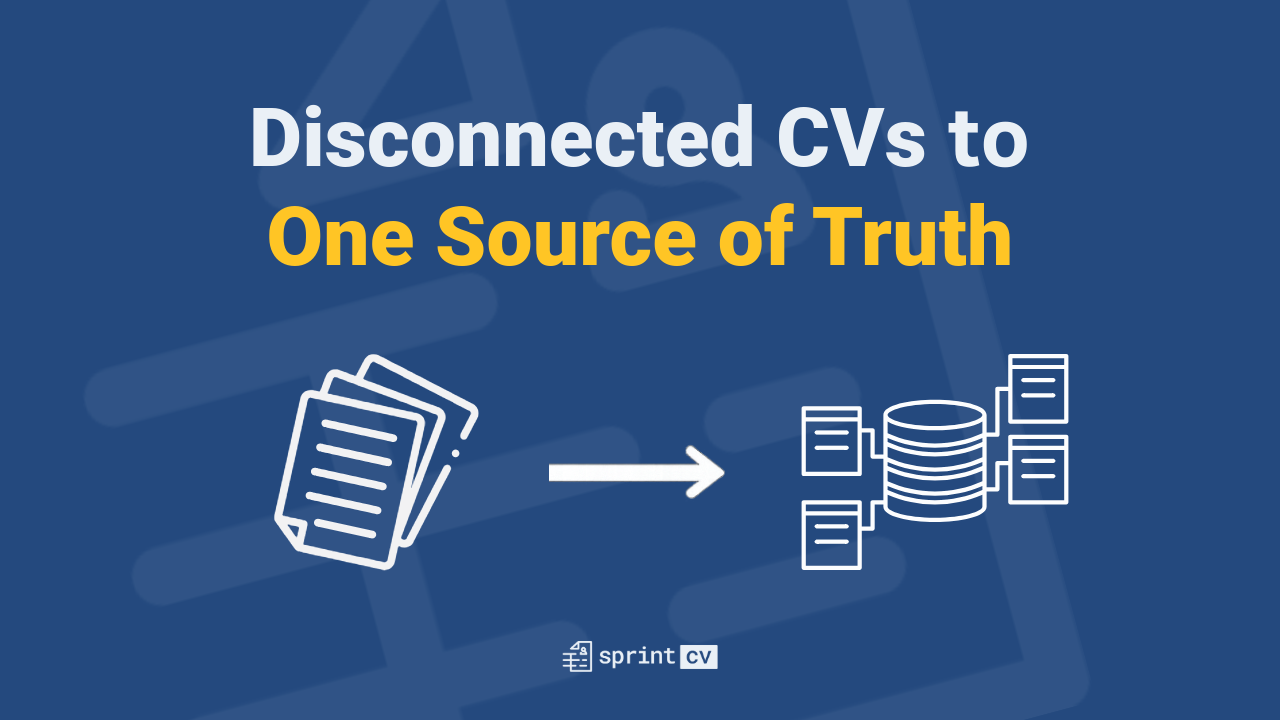
The shift is actually structural: from unconnected documents to a single source of truth that supports everything.
If this reflects what your team is facing right now, it would be useful to map it to your current workflow. Book a quick session with Sprint CV to review how your CV and project data are currently structured and where the manual work is actually coming from.
PakarPBN
A Private Blog Network (PBN) is a collection of websites that are controlled by a single individual or organization and used primarily to build backlinks to a “money site” in order to influence its ranking in search engines such as Google. The core idea behind a PBN is based on the importance of backlinks in Google’s ranking algorithm. Since Google views backlinks as signals of authority and trust, some website owners attempt to artificially create these signals through a controlled network of sites.
In a typical PBN setup, the owner acquires expired or aged domains that already have existing authority, backlinks, and history. These domains are rebuilt with new content and hosted separately, often using different IP addresses, hosting providers, themes, and ownership details to make them appear unrelated. Within the content published on these sites, links are strategically placed that point to the main website the owner wants to rank higher. By doing this, the owner attempts to pass link equity (also known as “link juice”) from the PBN sites to the target website.
The purpose of a PBN is to give the impression that the target website is naturally earning links from multiple independent sources. If done effectively, this can temporarily improve keyword rankings, increase organic visibility, and drive more traffic from search results.
