Recruitment leaders across Europe echo the same concerns: “We couldn’t find the right talent.”
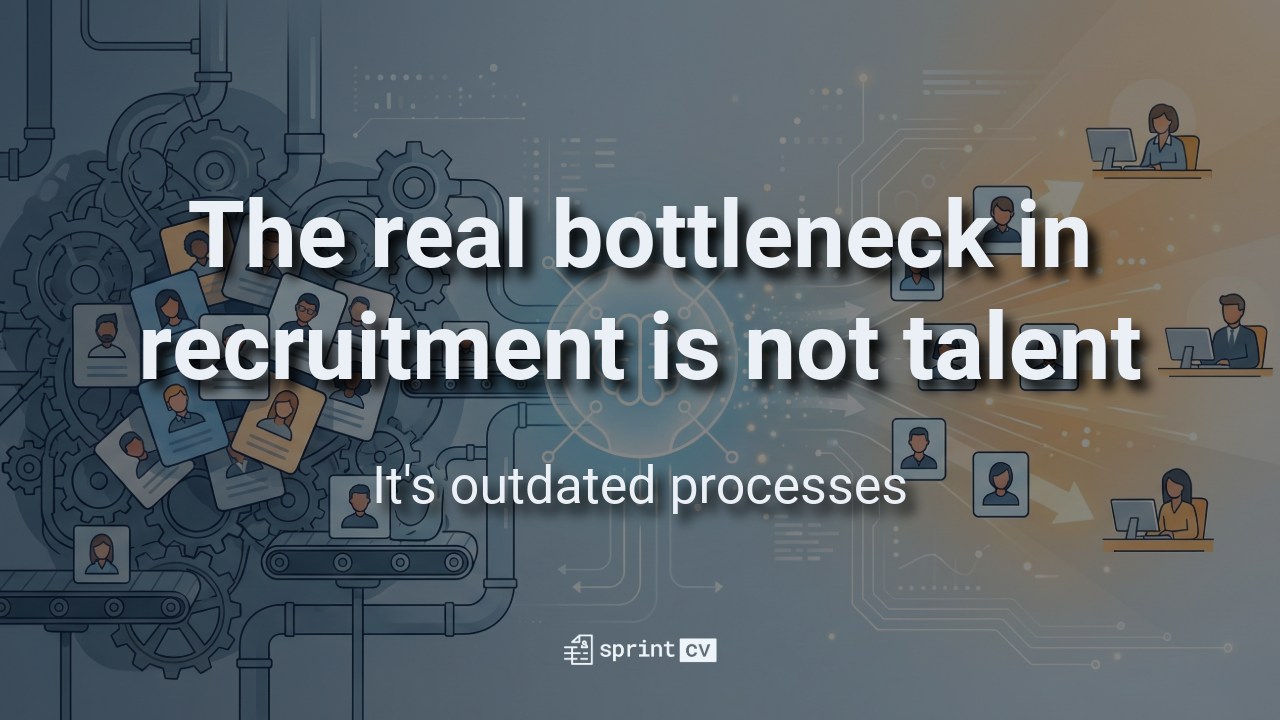
At first glance, this seems like a talent shortage problem. However, if we look closer, a different reality emerges. The market is not short of candidates. In contrast, many roles now receive hundreds, sometimes thousands, of applications. The real barrier in recruiting today is not talent. It’s an outdated process that can’t handle volume, speed, and quality at the same time.
As the recruiting market fluctuates and competition intensifies, companies that still rely on manual, fragmented and slow recruiting workflows will be left behind. Not because they lack good candidates, but because their systems can’t move fast enough to identify, prepare, and present those candidates well. This article examines why outdated recruiting processes are holding companies back, how these problems show up in daily operations, and what needs to change to keep recruiting teams competitive.
Talent abounds, attention does not
In today’s IT market, many recruiters face a paradox. They receive more CVs than ever before, but struggle to advance candidates. Instead of a talent shortage, there is an information surplus. When dozens or hundreds of CVs land in recruiters’ inboxes, attention becomes the scarcest resource. Every CV requires reading, formatting, adapting and aligning with client expectations. When this work is done manually, even strong profiles will be delayed or ignored. As a result, hiring managers often see poorly structured CVs, inconsistent candidate presentations, or late submissions. From their perspective, the problem looked like low-quality talent. In reality, the problem lies at the beginning of the process. The number of recruitment teams is decreasing, and there is no shortage of candidates.
The hidden costs of manual recruitment workflows
Manual processes rarely fail completely. Instead, they fail silently, through wasted time and missed opportunities. Many recruiting teams still rely on repetitive tasks such as copying information from one system to another, reformatting a CV for a different client, or rewriting a profile under time pressure. Individually, these tasks seem manageable. Over weeks and months, they accumulate and cause a massive loss of productivity.
More importantly, manual workflows scale poorly. As candidate volume increases, quality typically decreases. Recruiters are in a hurry. An error appears. A CV will be lost without proper alignment with the job description. Clients lose confidence, even when the underlying talent is strong. These hidden costs are not clearly visible in the KPIs. However, this comes down to slower placements, frustrated recruiters, and decreased client confidence.
Speed now determines recruitment competitiveness
Recruiting has always been competitive, but speed now plays a decisive role. In markets with lots of candidates, the fastest company to send a strong, aligned CV often wins. Clients don’t have to wait days to review a profile anymore. They select quickly, interview quickly, and move on. Outdated processes slow things down. When preparing one CV takes 20 or 30 minutes, recruiters can’t keep up. Even high-performing teams reach their peak. Modern recruiting requires a system that supports speed without sacrificing quality. Without that balance, even experienced recruiters will have difficulty competing.
When the ATS system alone is not enough
Many companies believe that their Applicant Tracking System can solve this problem. Unfortunately, this belief is often proven wrong. Most ATS platforms focus on candidate retention, not improving CV quality. They track applications and manage the pipeline, but don’t help recruiters tailor CVs to specific client needs. As a result, recruiters still rely on manual work outside the system. This creates a disconnect. The CV is in one place, editing is done in another, and submission is done in another. Every step creates friction, errors, and delays. ATS alone does not fix outdated processes. Without layers of intelligent automation, it will just be another database.
The problem of CV chaos is that no one wants to admit it
One of the most overlooked problems in recruitment is CV clutter. Candidates submit CVs in a variety of formats, languages and levels of detail. Some profiles downplay strong experiences. Others include irrelevant information or miss key skills altogether. Recruiters then spend hours cleaning, rewriting, and aligning the document before submission. In many cases, this chaos becomes the norm. The team accepts it as “part of the job.” Over time, they stop questioning whether these jobs should exist.
However, when CV preparation becomes a bottleneck, recruiters lose time on higher-value activities. Client communication is disrupted. Candidate relationships weaken. Strategic thinking disappears under operational pressure. Chaos is inevitable. This is a process failure.
Why process barriers keep companies stuck
If outdated processes cause so many problems, why do companies keep them? The answer is rarely budget alone. More often, resistance to change. Teams will get used to familiar workflows, even when they no longer work well. Leaders focus on output metrics without looking at daily inefficiencies. As long as the placement is carried out, no one questions the costs behind the placement.
Additionally, change takes time and learning. In a busy recruiting environment, teams feel they can’t afford it either. Ironically, this mindset actually reinforces the problems they want to avoid. Without clear leadership and ownership support, process improvements will be delayed indefinitely.
The human side of an outdated recruitment system
Outdated processes don’t just impact performance. They also influence people. Recruiters who are forced to spend most of their time on repetitive tasks often feel demotivated. Over time, this leads to disengagement and burnout. Talented professionals leave, taking their knowledge and client relationships with them. At the same time, junior recruiters struggle to develop strategic skills when their role focuses primarily on manual execution. This limits career growth and weakens team resilience. Modern recruiting should support people’s strengths, not suppress them. When processes harm people, everyone loses.
That said, we know that automation often sparks fear in recruiting teams. Many worry about losing control or relevance. However, automation does not remove recruiters from the process. This eliminates friction. When repetitive tasks disappear, recruiters have time to properly evaluate candidates, build stronger client relationships, and make better decisions. Automation shifts their role upward, not replaces it. Companies that understand these differences move faster. They invest in tools that enhance recruiter assessment, not replace it. As a result, they deliver better, faster and more consistent CVs. This is where real competitive advantage emerges.
From process barriers to process accelerators
The most successful recruiting teams treat the process as a strategic asset. They regularly audit workflows, identify bottlenecks, and remove unnecessary steps. Rather than asking recruiters to work harder, they redesigned the system to work smarter. CV preparation becomes faster. Quality increases. Clients receive a more aligned profile in less time. This shift does not require a massive transformation project. Often, targeted improvements in CV management have an immediate impact. When processes are accelerated rather than hindering progress, talent finally has room to shine.
Why CV quality still determines results
Despite advances in AI procurement and screening, CV remains at the center of it. It is still the primary document clients use to decide who to interview. In a competitive market, small details matter. A CV that aligns with the job description, is clearly structured and presented consistently will make a measurable difference. Recruiters who provide this consistently outperform those who don’t. Outdated processes make this level of quality difficult to maintain at scale. Modern equipment makes it achievable. Ultimately, recruiting success depends less on finding unicorns and more on effectively bringing in real talent.
Rethink recruiting from the inside out
The real barrier to recruitment is not the availability of talent. This is the inability of outdated processes to handle modern demands. Companies that recognize this reality will gain a strategic advantage. They stop blaming the market and start fixing what they control. By modernizing workflows, reducing manual effort, and improving CV quality at scale, they unlock existing performance. Recruitment does not require more candidates. A better system is needed to support existing talent.
News
Berita Teknologi
Berita Olahraga
Sports news
sports
Motivation
football prediction
technology
Berita Technologi
Berita Terkini
Tempat Wisata
News Flash
Football
Gaming
Game News
Gamers
Jasa Artikel
Jasa Backlink
Agen234
Agen234
Agen234
Resep
Cek Ongkir Cargo
Download Film
