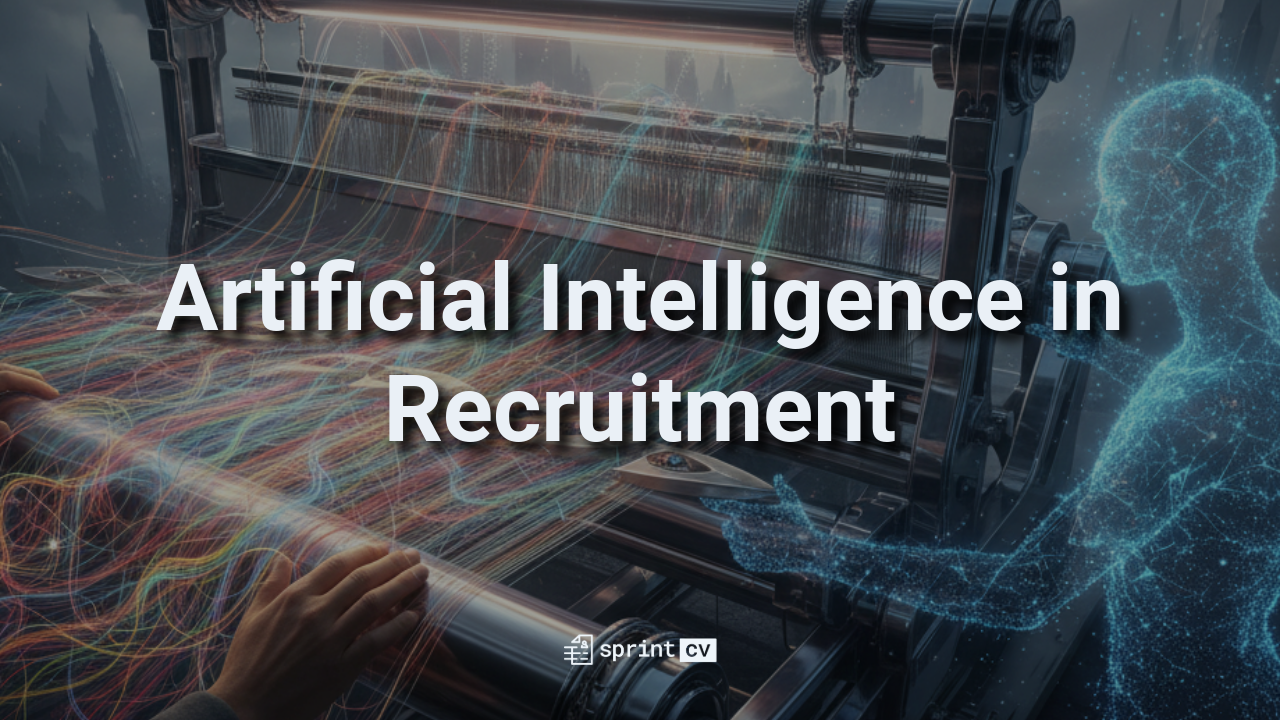
There is a lot of discussion about the role of Artificial Intelligence in recruitment. Many companies are looking for new tools to speed up their work. At the same time, more and more organizations are banning the use of AI due to compliance concerns. EU AI law and the AI Code of Practice add even more pressure, with regulations around transparency, security and content ownership.
Amid all this noise, one simple idea is lost. AI is a tool that follows the instructions you give it. It doesn’t create intent. It doesn’t replace your skills. It just reinforces the quality of what you’re asking for.
This article explains why AI in recruiting is often misunderstood, why humans are always the authors of the content, and how recruiters and consultants can use AI safely and responsibly.
Artificial Intelligence in Recruitment: Why We See AI as More Complex Than It Really Is
When people look at AI through a regulatory lens, they see risks. When they look at AI through the lens of everyday work, they see a very helpful assistant. Both views are valid, but much of the fear comes from imagining AI as an independent actor.
The AI won’t know your ideas unless you feed them to the tool.
AI doesn’t write a CV unless you provide the information.
AI doesn’t make decisions unless humans tell it how to classify something.
Think of it as a high-speed editor. When you provide good context, it writes a clean version of what you already know. If you provide weak or incomplete instructions, the results will reflect that. Quality always comes from the human guiding the process.
This is why people who learn how to write effective commands will get better results. They do not control the tool. They communicate with him, such as giving instructions to colleagues.
The Human Writer Always Remains in Control
A common concern in the market is ownership. Who is the author of the CV or document created with AI support. The answer is simple. The writer is always the one who provides ideas and validates the results.
Imagine you write a book and hire an editor.
Editors rewrite sentences, build structure, and clean up grammar.
No one will say that the editor is the author of your book. You provide the story, the purpose and the message. The editor just shapes it.
AI plays the same role. It rewrites based on your directions. This improves what you describe. This follows your best practices. It can’t create your experience.
This becomes very clear in CV writing. Many of the best structured CVs on the market today have been perfected with the help of AI. Candidates share their responsibilities, accomplishments and goals. AI reformulates the text using known best practices in CV writing. The content still belongs to the candidate. This tool simply improves clarity and presentation.
For example:
A professional with a mixed background in management and technical work might ask an AI assistant to highlight technical skills for a particular role. The assistant rewrites the text with that focus. The idea is still the candidate’s idea. AI acts as an experienced editor.
Artificial Intelligence in Recruitment – What EU AI Law Means in Practice
EU AI legislation aims to reduce risks and create transparency. This is positive for the market. The challenge is that these regulations are complex and often open to interpretation. Many organizations worry about compliance before they fully understand how AI is used in their daily workflows.
Most companies do not use AI to make decisions.
They use AI to automate small tasks.
They use AI to generate drafts.
They use AI to clean up text, not to replace judgment.
These situations are considered low risk when humans remain responsible for the final action.
Confusion occurs when people imagine AI running the recruitment process without any oversight. Such a scenario is inappropriate and undesirable. AI should support recruiters, not take control of hiring decisions.
AI Should Help, Not Decide
In recruiting, human supervision is very important. Decisions that impact careers and opportunities should not be completely automated.
AI can read CVs faster than any human.
It can highlight hard skills.
It can create summaries that help recruiters understand profiles more quickly.
What they cannot do responsibly is make the final decision.
At Sprint CV, we use two layers of assessment to illustrate this. One layer summarizes the story on the CV. The second layer looks at hard skills. This combination helps recruiters see patterns more clearly. However, the recruiter always makes the final decision. AI prepares information but does not determine the outcome.
This approach respects the aims of the EU AI Law and puts humans at the center of the process.
Why AI Tools Are Still Safe If Used Correctly
Much of the panic around AI occurs because people imagine extreme scenarios. They describe tools that replace work, change meaning, or act with autonomy. In fact, AI behaves like any other assistant.
It does the heavy lifting.
You do the final review.
You decide what to send to clients or publish on your CV.
The workflow is simple.
You provide the text.
AI rewrites or organizes text.
You agree to the final version before sending it out into the world.
This is the same process that companies have followed for years with interns, assistants, or external consultants. The only difference is speed.
Real Skills of the Future: Knowing How to Work With Artificial Intelligence in Recruitment
As AI becomes a standard part of recruiting tools, new skills become essential. Professionals who know how to communicate with AI get better results. They understand how to provide context, how to provide constraints, and how to determine expected outcomes.
It’s similar to learning a programming language, but more accessible.
This requires clear thinking, curiosity and practice.
For example:
A recruiter might ask an AI assistant to rewrite a job description in plain English.
A consultant might ask him to clean up the grammar in the CV and write everything in the third person.
A manager might ask him to create two versions of a profile, one technical and one managerial.
None of these actions replace human expertise. They just reproduce it.
Artificial intelligence in Recruitment – Use AI Safely and Effectively
Here’s a simple guide for recruiters who want to follow best practices while remaining compliant:
Keep AI as an assistant
Let it summarize, rewrite, or extract skills.
Always review the results before sharing them externally.
Avoid complete automation of decision making
Use AI to rate or classify content, but the final decision remains in the hands of humans.
Provide clear and complete context
The better the instructions, the more accurate the results.
Focus on transparency
If your internal processes use AI to help organize or summarize, document them.
Transparency builds trust, both internally and with clients.
Understand what the EU AI Law actually does
Most text rewriting and content cleanup tasks fall into the low risk category.
High-stakes cases involve automated decisions that affect a person directly.
Hiring teams rarely reach that level if they follow good human oversight practices.
Why the Market Needs a More Practical View of AI
The future of recruiting will not be shaped by fear. It will be shaped by a team that understands how to combine human judgment with AI efficiency.
EU AI law will continue to evolve. Tools will adapt. New best practices will emerge. Through all of this, one truth will remain: AI will only be as good as the humans guiding it.
Recruiting is a people business. AI simply gives people more time to focus on the important parts of the job. Talk to candidates. Understanding clients. Make informed decisions.
Companies that use AI as a responsible assistant will move faster, deliver better work, and stay ahead of compliance requirements. Companies that freeze will lose productivity without gaining any real security.
Artificial Intelligence in Recruitment – Final Reflection
AI in recruitment is not a threat when used correctly. It is an editor, assistant and productivity enhancer. Humans always provide ideas, validate content, and are responsible for the final decision.
Instead of being afraid of AI, we can learn to guide it.
Rather than banning AI completely, we can set clear rules about how such tools support our work.
Instead of imagining AI as a decision maker, we can treat it as a partner that helps us think, write, and communicate faster.
This balanced approach respects humans at the center of recruitment and remains aligned with EU AI Law. This also unlocks the real potential of modern tools. With the right framework, AI becomes simple again.
Ready to find out how AI can transform your recruiting workflow? Book a demo with us and find out.
News
Berita Teknologi
Berita Olahraga
Sports news
sports
Motivation
football prediction
technology
Berita Technologi
Berita Terkini
Tempat Wisata
News Flash
Football
Gaming
Game News
Gamers
Jasa Artikel
Jasa Backlink
Agen234
Agen234
Agen234
Resep
Cek Ongkir Cargo
Download Film
